
Overview Foreword Biography Stories Venues Acknowledgements
EMILIANO
TREE OF NEW LIFE
I am an architect and I moved from Mexico City when I was 21 to live in Sydney.
I was 10 when the Olympics were held in Sydney. I remember seeing a TV show for children about the everyday life of school students in Australia – a visit to the beach in the morning before class, and a bush walk in the afternoon before bed. I realise now that the program employed some creative license, but the prospect was enchanting to a young person living in Mexico City, a tightly packed and sprawling, concrete metropolis.
Mexico City accommodates more than 26 million people, with everyone energetically jostling for space. Although Sydney is a vibrant place, it is much calmer than my city. When I first arrived, it was a dream-like vision, as if looking through rose-tinted glasses. Soon I understood that Australia also had difficult issues to contend with.
The process I experienced obtaining my visas (three student visas, one working, one skilled, and a citizenship) was complicated by my nationality. The administrators asked a lot of me – to undergo numerous police checks, and to divulge intimate details about my parents, grandparents, and greatgrandparents. The applications cost tens of thousands of dollars over many, many months, a significant expenditure of time and money that I negotiated alongside full-time study and work.
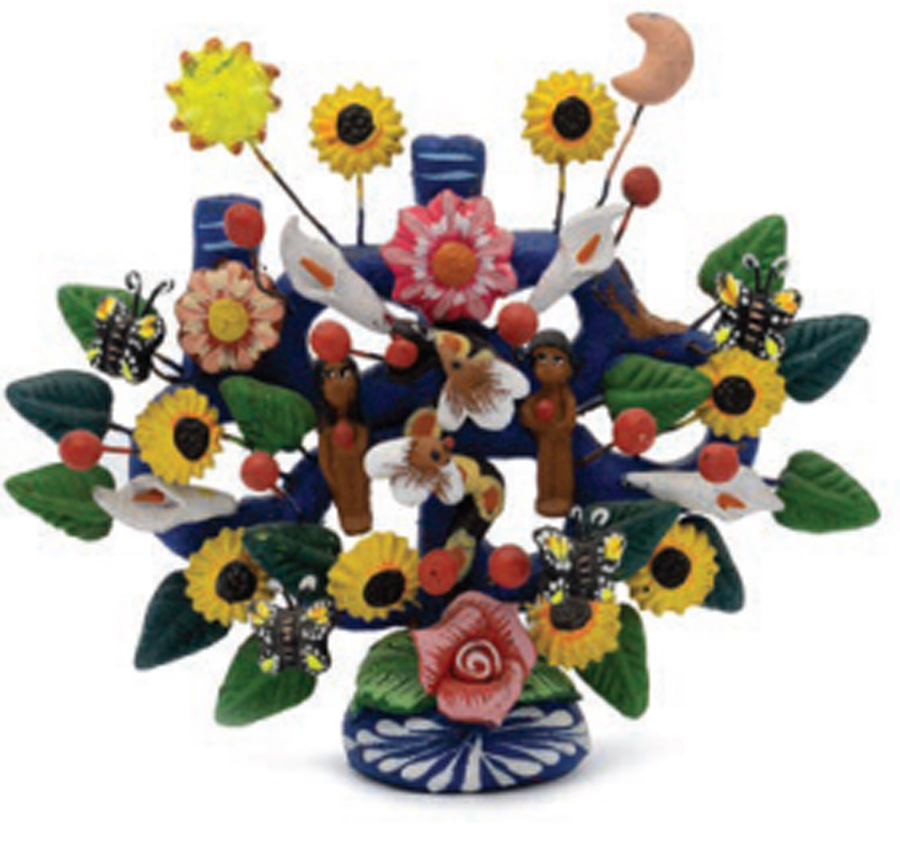
My object is a traditional Mexican ‘Tree of Life’, crafted from fired clay. Trees of Life are made in a town near Mexico City using Indigenous pottery techniques. In contrast to their fabrication, these ceramics have historically portrayed a colonial and biblical scene – Adam and Eve in the Garden of Eden. The religious origins of these objects have largely been detached in recent years and Trees of Life now depict all kinds of secular iconography. The tree I have was given to me by an aunt as a farewell gift, a token of good luck for my journey to Sydney. She told me to take care of it so I wouldn’t forget where I came from.
These objects are very delicate and break easily. They’re handcrafted and can be expensive for a working-class family like mine. When I unpacked on my arrival in Sydney, I found that beneath the bubble wrap and folded t-shirts, a branch had chipped.
I had set out to honour my aunt’s wishes and to protect the gift at all costs on my journey. Yet the broken limb came as a relief, as if a sign that I should prioritise my own happiness for the first time instead of the cultural responsibilities that I had inherited. I kept the tree and promised that I would repair it when I found the time.
Thirteen years later, I have not fixed it, however I have carried it with me ever since. I like it more as a broken object as it gives me a chance to oblige the family mandate on my own terms. What has made my migration to Australia both meaningful and sustainable is the ‘breaking’ of old rhythms and habits, and the flourishing of new ones.
Vipoo took this broken sculpture and created a new Tree of Life with a large root system symbolising Emiliano’s settlement in Australia. He also made a small altar for the original tree, featuring two golden figurines representing Emiliano and his Australian partner caring for the tree and their new life as a couple.
JOOYUN
HANDLE WITH CARE
My name is Jooyun. I have lived in Stanthorpe, a rural town in Queensland, for 13 years.
I mostly do farm work for a living – packing, thinning, picking and pruning apples, blueberries, strawberries and blackberries.
I moved from Korea to Melbourne in 2010, as my brother-in-law had lived here when he was young. I couldn’t speak much English, so I was in a kind of culture shock. I hung around with Koreans having fun in Melbourne, and so I didn’t experience much of Australia.
I didn’t enjoy life in Melbourne, so I only stayed about six months. I was already 30 years old and working in the Korean restaurants for pocket money. I studied English in Language School but didn’t travel much.
I have a permanent visa now. The process was a bit more complicated than getting a working holiday visa as you need to prove your relationship, pay more fees and follow the long process.
I think language is the hardest part, because in the first six months, I couldn’t speak English at all. I have been living in Queensland, and it’s a totally different vibe from Melbourne as it’s a rural country town. Back then I felt like an alien. People look at you, staring, and they don’t understand you. Living in the countryside is different. There is a lot of space and the people are more relaxed and there are grasses everywhere and animals around.
When I go to Korea now, there are too many people and the sky’s different … it’s grey. I can’t live in the city anymore because I have changed a lot living in the countryside and working on the farm for so many years. I feel more relaxed but a bit behind though, maybe because it’s a more isolated life.
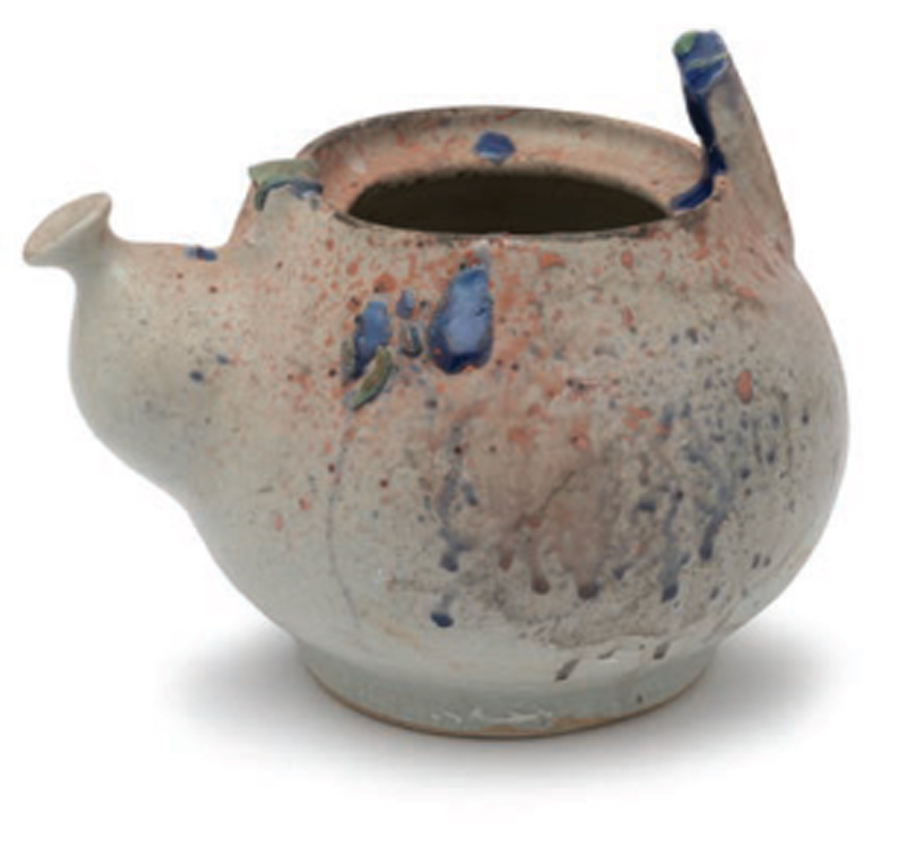
My object is a porcelain teapot. I made teapots as part of my wheel throwing practice in university. If you make a good teapot, you are kind of there. I tried lots of different designs and started carving as well. The teapot I have chosen has a cracked handle as it didn’t survive the glaze firing. It’s hard to use as a teapot so I use it as a pot plant.
Even though the teapot has a broken handle, I am attached to it … it’s a kind of obsession. It brings me back to university memories – the campus and the people, and all of us wearing our aprons. Twenty of us used to sit around, all dirty with clay, and eat food. It was a fun memory.
Many of my teapots had no handles as they were damaged in the firing. I didn’t want to leave them behind as they are part of me. I now do pottery on the weekend in my little garage after working on the farm during the week. I enjoy making them but I am worried too. Where are they all going to go when I’m not around? They are me; they are my babies. I don’t have human babies of my own, ha ha! I will need to work harder to find them a home.
Vipoo explores Jooyun’s story by creating a large pregnant teapot deity with Jooyun’s teapot inside as a baby. Inside the teapot is a small golden gumtree representing Jooyun’s decision to become Australian. The sculpture is adorned with many teapots and various fruits that Jooyun used to pick when she first arrived in Australia.
LENE
CORNFLOWER DREAMS
I came to Australia in 1985. I’m still a Danish citizen. I did my four years of training as a ceramicist in Denmark from 1974 to 1978.
I met my (now) husband in Greece when we were both on holidays. After experiencing a long dark winter in northern Norway, Peter wanted to return to Australia and asked me to come with him. I spent nine months here, seeing the country, and I even had a job. I then returned to Denmark for three months to sort out my affairs and pack up my belongings so I could move to Australia. I’ve enjoyed a 30-year career in ceramics in Australia, working from a home studio and balancing work with family life.
My first visa was only a tourist visa, but when I emigrated, I had to be interviewed at the embassy in Copenhagen. I had a piece of paper that said we would get married in three months. If you didn’t get married, then you would be sent home.
I didn’t know much about Australia. I had seen an exhibition of Aboriginal paintings in Copenhagen along with a ceramics exhibition which featured a large pot by Milton Moon. I remember as a child of around 10, my parents rented a beach house. Nearby was a dune with some clay. My sister and I dug the clay and made little pots with it, pressing flowers into them.
When I decided to come here, I sorted my things to be packed but it ended up being packed by someone else. It was a box, a cubic meter of stuff. When I saw this box on the lawn in Preston, I thought, “Oh, no! I have really done it. I have really moved”. This box contained my earthly belongings – my bicycle, my sewing machine, quite a bit of pottery and clothes. It was a big decision.
The moment that I felt like Australia was my home was when I realised I had lived here for more years than I had lived anywhere else. I’ve been lucky to go back many times with my children. I wanted them to know the culture and it helped me to keep a bit too.
You have to throw yourself into something [like moving to another country] … it’s a leap of faith. It’s like, “If I don’t do it, will I regret that I didn’t do it?” You can’t predict the future and so you just must make the best of it and be happy with what you have done.
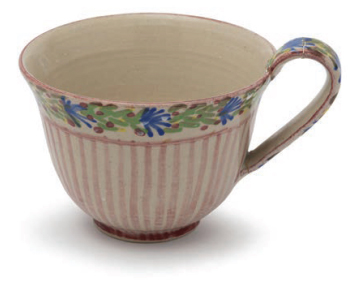
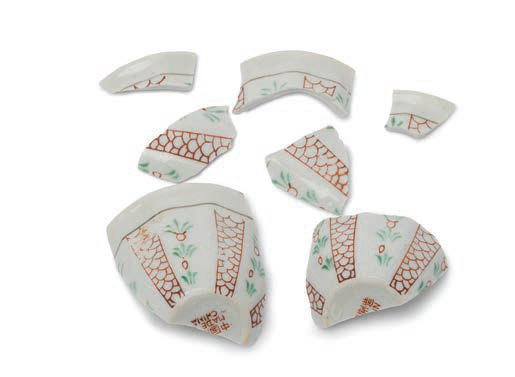
My wheel thrown cup (with a broken handle attached to the rim) was made at a pottery in Copenhagen where I worked for five years. I remember making those handles because coming straight from the rim was a bit different. I don’t recall how the handle was broken, but I used glue to fix it as I didn’t want to lose the pieces.
Underneath the cup is the stamp of the pottery as well as the signature of Henriette, the designer and decorator. I brought this cup with me when I immigrated to Australia in 1985 and for me it symbolises the hope I had that one day I would establish my own studio.
Inspired by the cornflower pattern, Vipoo created a deity with a cornflower head crowned by Lene’s cup. Inside the cup is a beach house where Lene first experienced pottery making as a child. The deity is adorned with multiple handles and hands, symbolising the collective effort in crafting a single teacup. The hands form a ‘V’ sign representing Lene’s triumph in realising her dream in Australia.
BECCA
FROM COURGETTES TO ZUCCHINIS
I live in Newcastle (NSW). I married an Australian in England and moved here with him in 2011. To get my visa we had to provide evidence that we’d lived together for every three months for four years.
A year after arriving here, we broke up and I stayed. About six years later, I became a citizen. It cost a lot of money and there was lots of waiting around and uncertainty. Small things would remind me that I was far from home, like at the supermarket checkout looking for courgette under C, then realising in Australia it’s called zucchini.
The sun is out, the skies are blue, the people are nice, and you can live a good life. The best things in Australia are free – the beaches, the parks and the outdoors. I laugh at how you take an esky to barbecues. Everything must be on ice all the time; there is an obsession with ice! I love kids’ parties in the park and sausage sizzles at Bunnings.
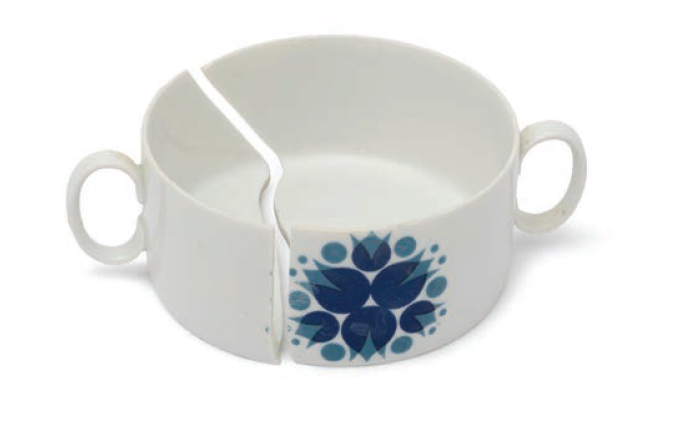
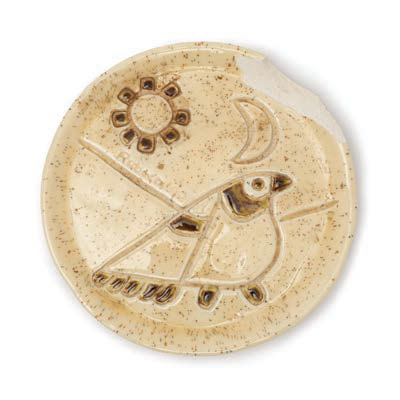
My family is Jewish so on Friday nights, at my grandparents’ home, we would have chicken soup with little dumplings in these soup bowls and using our nest crockery. These awkward, funny but delicate bowls are a strong childhood memory. The elegance and the design were a part of how I remember my grandparents – two architects, the heads of our family, the providers of a sense of history and style.
When my grandparents died, I inherited a set of four bowls. When I moved here 12 years ago, they came with me but with kids it’s hard. All that is left now are two broken bowls which live in a drawer. After many decades in use, I’m sad that they broke on my watch. For me, they speak of the connection to family and those Friday night dinners … just being there was enough. While I am not religious, I’ve carried the tradition on and so we always have our meals at the table using our nest crockery; we like using the beautiful things.
It’s a lovely opportunity to not have to let it go completely, but to let the bowls be transformed into something else, so the memory can live on.
For Becca’s story, Vipoo created a figurine featuring the sun and sky on the back. At the front, one hand holds barbecue tongs while the other holds a bottle of beer, depicting a sunny day barbecue in the park. The head is an esky with a courgette lip. On top of the esky is Becca’s broken bowl, within which is a pile of little dumplings topped by a golden chicken. One leg of the figurine is decorated with a kangaroo motif, Australia’s national animal, and the other with a lion motif, the UK’s national animal, together telling the story of Becca’s journey.
CYRUS
THE ESSENCE OF ANCESTRY
I was born in Hong Kong and after studying and working as a social worker, I moved to Australia in 2003 using the skilled migration program. The Permanent Residency application process was quite complicated. I tried to fill the form in myself to save money.
I also had to do an English test to prove my English was good enough. I needed a lawyer to sign all my certificates and I had to register as a social worker with the Association Board …there were so many procedures! My Permanent Residency Visa later enabled me to study visual arts.
Moving to Melbourne was a dream for me and a huge challenge with lots of surprises. I was very excited! But when I first arrived, I was lonely and regularly called friends back home. I was surprised the city was so small, more like a country town. All the shops closed at six o’clock, a big difference to Hong Kong.
Most special to me now is walking barefoot and having a picnic on the grass as this never happened in Hong Kong.
This little ceramic cup I have chosen brings back memories – the first being a special moment with my family and the second is of my dad (now passed).
After my mother left when I was nine, my grandma moved in with us. Grandma prepared delicious herbal soups like salty fish head soup and pig lung herbal soup, giving me the opportunity to enjoy homemade meals.
About two years later, when I was 12, my grandma passed away. On the day of her funeral, my father wore black instead of the traditional white and brown burlap robe. He asked my brother to participate in the graveside ritual of burning incense and joss paper money while he remained behind. It was the first time I saw my dad shed tears. Later, I learned that he couldn’t fulfil his duties as a son because he had converted to the Baptist faith to marry my mom.
Later, when we moved to a bigger house, my dad demanded to have a shrine created at home.
So, this little cup was filled with wine, and along with some food and paper money, my grandma’s photo, and the burning of Chinese incense, we would hold a ritual during which we poured the wine from the cup onto the ground as an offering to the ancestors. It made me realise the regret my father carried for never having the opportunity to fulfil his filial duties towards grandma’s welfare in the afterlife.
This object I have chosen helps to anchor me to that memory, both of my grandma and my dad. As I get older, I worry that this memory of mine is fading. The cup helps me to hold on to it.
Touched by Cyrus’s story, which highlights the importance of family, Vipoo created a large deity. One hand holds a fish head soup, a dish her grandmother used to cook for her, while the other hand holds a plate carrying the wine cup, ready to be offered for ancestor worship. Vipoo also created a smaller figurine that could represent either Cyrus’s father or brother, both of whom play important roles in her life. Atop the deity is an abstract sculpture inspired by a spirit tablet. This deity represents personal memories and embodies the core values of ancestor worship and ritual, fostering social unity.
REBECA
SKIPPY AND THE DOG
I live in Newcastle (NSW). I married an Australian in England and moved here with him in 2011. To get my visa we had to provide evidence that we’d lived together for every three months for four years.
A year after arriving here, we broke up and I stayed. About six years later, I became a citizen. It cost a lot of money and there was lots of waiting around and uncertainty. Small things would remind me that I was far from home, like at the supermarket checkout looking for courgette under C, then realising in Australia it’s called zucchini.
The sun is out, the skies are blue, the people are nice, and you can live a good life. The best things in Australia are free – the beaches, the parks and the outdoors. I laugh at how you take an esky to barbecues. Everything must be on ice all the time; there is an obsession with ice! I love kids’ parties in the park and sausage sizzles at Bunnings.
My family is Jewish so on Friday nights, at my grandparents’ home, we would have chicken soup with little dumplings in these soup bowls and using our nest crockery. These awkward, funny but delicate bowls are a strong childhood memory. The elegance and the design were a part of how I remember my grandparents – two architects, the heads of our family, the providers of a sense of history and style.
When my grandparents died, I inherited a set of four bowls. When I moved here 12 years ago, they came with me but with kids it’s hard. All that is left now are two broken bowls which live in a drawer. After many decades in use, I’m sad that they broke on my watch. For me, they speak of the connection to family and those Friday night dinners … just being there was enough. While I am not religious, I’ve carried the tradition on and so we always have our meals at the table using our finest crockery; we like using the beautiful things.
It’s a lovely opportunity to not have to let it go completely, but to let the bowls be transformed into something else, so the memory can live on.
For Becca’s story, Vipoo created a figurine featuring the sun and sky on the back. At the front, one hand holds barbecue tongs while the other holds a bottle of beer, depicting a sunny day barbecue in the park. The head is an esky with a courgette lip. On top of the esky is Becca’s broken bowl, within which is a pile of little dumplings topped by a golden chicken. One leg of the figurine is decorated with a kangaroo motif, Australia’s national animal, and the other with a lion motif, the UK’s national animal, together telling the story of Becca’s journey.
SULTANA
GODDESS OF INDEPENDENCE
We migrated to Perth in 1982 for a better life. We could have lived anywhere, but Australia opened an opportunity and we took it.
We married very young, and I used to sail on cargo ships with my husband, a marine engineer. He got a job immediately, so we didn’t have the usual refugee or migrant experience with the trauma of waiting to see if we were accepted.
We had been to South Africa and experienced apartheid, so we were a bit apprehensive coming to Australia as we had heard that Australia had the White Australia policy in the past. Instead, we found people very friendly. Since that time, we travelled and lived in many other countries as well – UK, Thailand, Cyprus, Singapore. I bring all these cultural influences into my life in Perth.
Contemporary jewellery allows me to express myself as an artist and craftsman and experiment with non-traditional techniques and tropes.
Language wasn’t a problem because we spoke English, but the understanding and the use of the language was an issue. In India, family, community and hospitality is part and parcel of daily life. One was always going to other people’s homes to eat; people are coming over to eat. It was different here, more formal. You had to tell them you were coming in advance and go at the exact time. Just dropping in, without making an appointment, wasn’t on.
If you’re going to leave your country, develop an extra layer of skin. I didn’t like the way I was patronised when I came. As a small brown woman who speaks with an accent, people were always nice, but patronising, thinking I needed to be educated about life in Australia. I’d also say to someone moving to Australia, “come, the world needs to be mixed up” … the eggs are already broken, and this is the omelette that we’re in, all mixed up and creating a new reality. I think the future should look like the world is one country and we are all citizens.
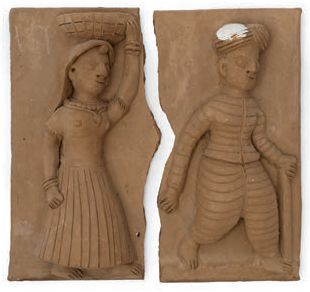
My object is a terracotta tile made in Gujarat, the Indian state where my family originated. This tile was part of a set of three depicting a farming couple going forth, the man leading the woman, very much like how I followed my husband to settle in a new and unknown land with our children.
Although I carefully packed it, when I opened the box, it had split into two, separating the man and the woman. Years later my husband and I separated, a casualty of cultural differences.
I also feel there is a strong Thai connection in my chosen piece. When I was in college studying ceramics, there was a Thai student in my class called Piansuk who read my tarot cards. She said, “Hey, do you know in the next week someone’s going to ask you to marry him?” I dismissed it because I didn’t have a boyfriend, but then my husband, who I had met five years before, suddenly came back into my life the following week saying he wanted me to marry him. We later divorced in Bangkok, Thailand, so the Thai connection showed itself again, at the beginning and at the end. And now I send you, [Vipoo] a Thai ceramicist, a piece that connects me again.
To honour this object, Vipoo decided to work with terracotta for the first time, departing from his usual white porcelain. He created a temple-like space inside the sculpture to place the tile as a goddess, honouring her resilience, independence and the significant milestones in her life, thus encapsulating her story within its form.
VIPOO
DANCE OF DREAMS
With seven sculptures completed, Vipoo decided to add an eighth piece to capture his own experience of immigrating from Bangkok to Melbourne in 1996. He used a blue and white porcelain button belonging to his grandmother as the starting point. The button reminded him of the time spent with his grandmother, who encouraged his love for Thai traditional performance. It now holds his old dream of becoming a Thai classical performer. Rediscovering the button made Vipoo realise his love for blue and white ceramics might have started with it.
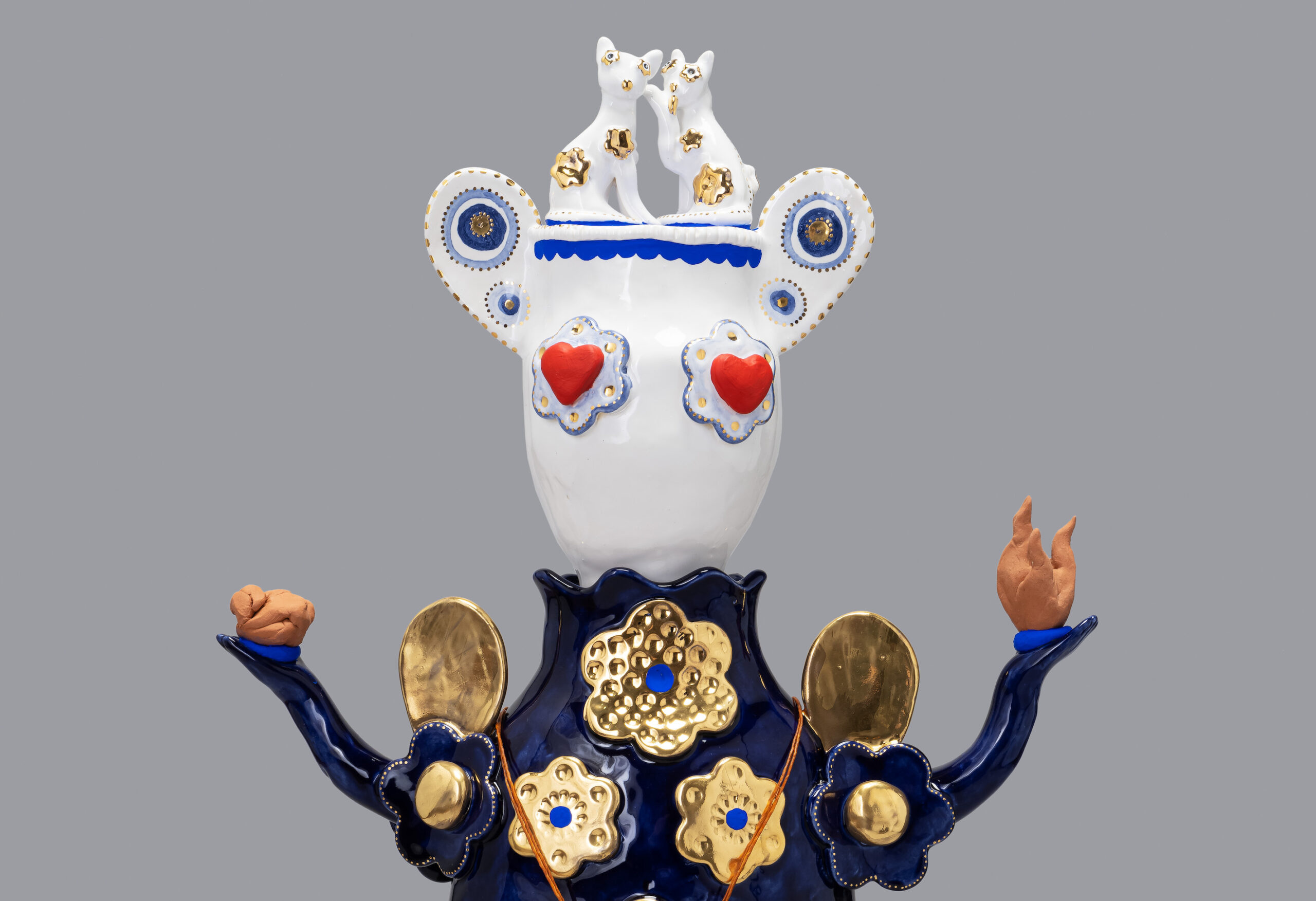
The figure he created is posed in a classic Thai dance, arms stretched out to form a half-circle. One hand holds a flame, the other a lump of clay, both vital for his creativity. The heart-shaped eyes symbolise the love he found in Australia nearly 30 years ago. At the top sit two of his beloved Burmese cats. He turned the button into a pendant for the sculpture. The base of the work is decorated with figurine motifs representing the friends he found in Australia. This artwork intertwines past dreams and present passions, blending cultural heritage with personal experiences and relationships.